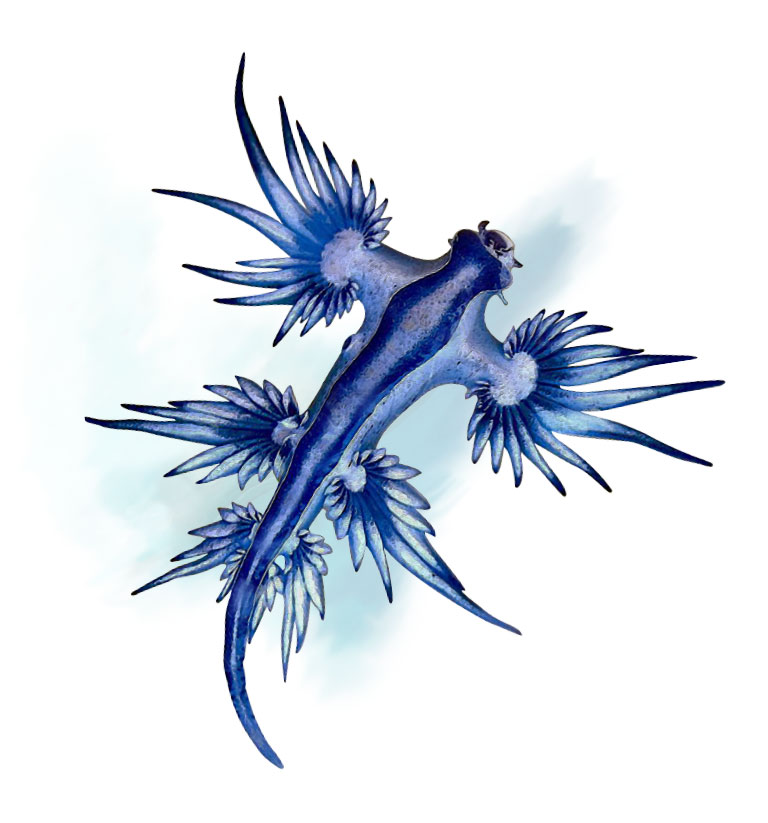
The blue glaucus, which is also called the blue dragon, sea swallow, or blue angel, is a brightly colored nudibranch, commonly known as sea slugs. Found throughout the Atlantic, Pacific, and Indian Oceans in tropical and subtropical waters, the blue glaucus grows up to 1.2 inches (3 cm) long. These tiny sea slugs spend most of their lives floating upside-down at the surface, staying afloat by storing air bubbles in their stomach.
Distribution
Ecosystem
Feeding habits
Taxonomy
Atlantic, Pacific and Indian oceans
Open ocean
Foraging predator
Order Nudibranchia, Family Glaucidae
Seven Traits of the Blue Dragon
Though part of the nudibranch family, the blue dragon is vastly different from your average sea slug, and is known to be pelagic, using the ocean currents to carry it along.
The blue dragon floats upside down for camouflage: Its blue side faces upwards to blend with the blue water, while the downwards facing silver side blends in with the ocean's surface.
They only feed on venomous creatures, often much larger than itself, such as the Portuguese man o' war and can deliver a powerful sting to paralyze its prey.
The immune system of a blue dragon is built to resist the venom of its prey.
All blue dragons are hermaphrodites, meaning they have both male and female reproductive organs.
When two blue dragons mate, they both produce egg strings. These egg strings lack a hard substrate to attach to, and are often left to float freely in the water or are placed on the remains of their prey until the larvae hatch.
These little slugs have the amazing ability to swallow the nematocysts of its venomous prey.